How to Start Making Changes - According to Science
You ever feel that familiar pull to reset – to change something about your life, start fresh?
Maybe you want to break a habit, create a routine, or implement a daily practice, and are curious where to begin - that’s where science comes in.
By combining research from the fields of behavioral science, cognitive & nutritional neuroscience, and psychology - a recurring pattern emerged: self-awareness & self-care strengthen the skills needed to initiate, support, and sustain behavior change.
This resource connects these findings - illustrating self-awareness & self-care as research-informed starting points for sustainable behavior change.
The Science Behind Sustainable Change
Research highlights three key areas of focus central to initiating & maintaining behavior change:
self-regulation: the ability to manage our thoughts, emotions, and behaviors to achieve a desired goal
stress reactivity & resilience (stress management): our ability to identify and handle stress - including how we react to it & how well we recover from it
interpersonal & social processes (social connections): our ability to feel a sense of belonging & closeness with others through communication & shared activities - and how those connections shape our choices and experiences
Within these three key areas, researchers identified mental, behavioral & social skills associated with behavior change success.
Prioritizing practices that strengthen those skills make sustainable behavior change easier and more likely to occur.
Self-Awareness & Self-Care for Sustainable Behavior Change
Self-Awareness & Self-Care →
enhance our ability to
→ regulate our thoughts, emotions & behaviors
→ respond to & recover from stress
→ navigate social interactions & better engage with others
Individually, self-awareness & self-care reinforce the key areas of sustainable behavior change.
Together, through a reinforcing system of insight & action, they continuously strengthen each other.
Self-Awareness ⇄ Self-Care →
Sustainable Behavior Change
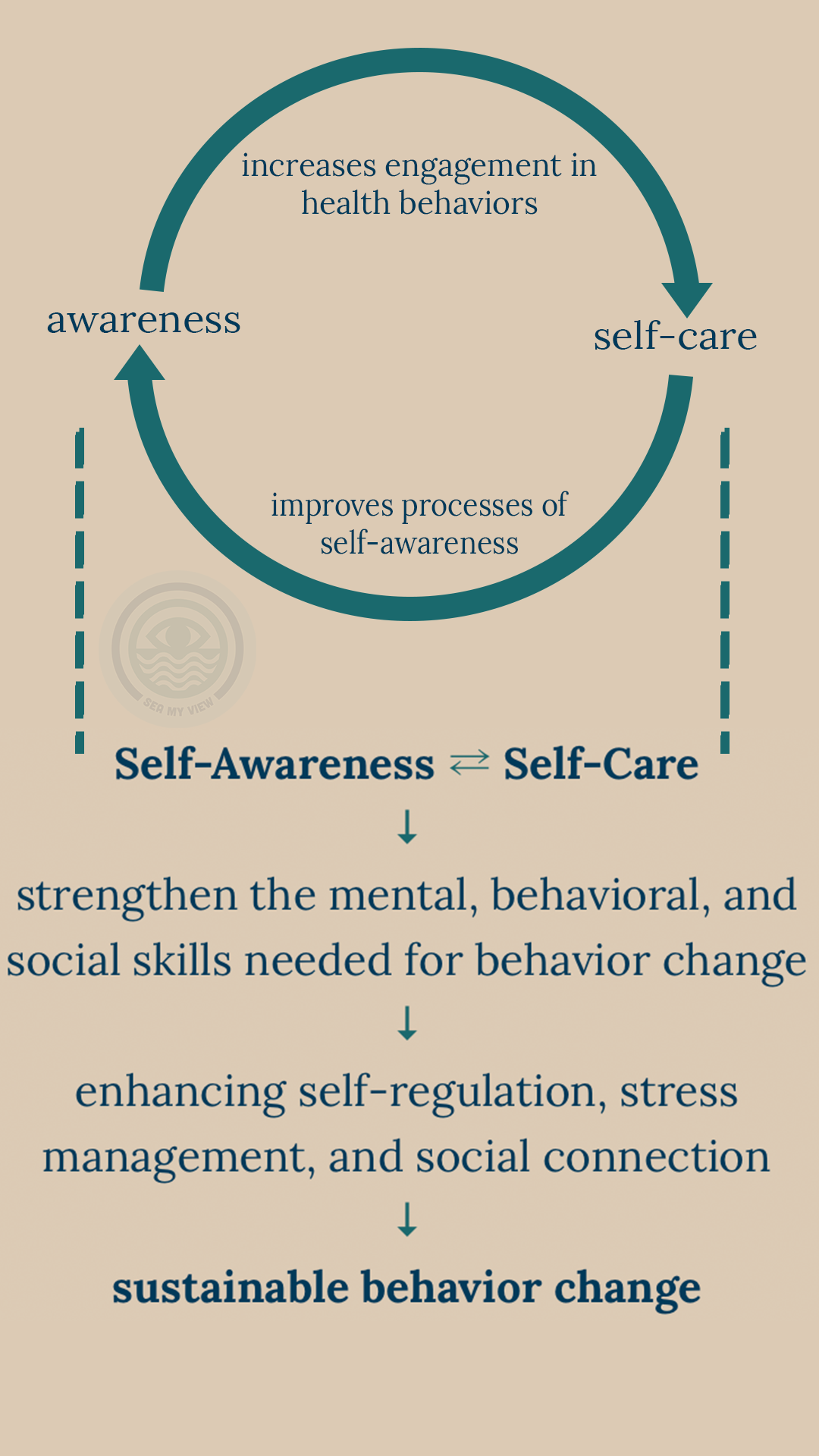
Start Here for Sustainable Behavior Change
“Until you make the unconscious conscious, it will direct your life and you will call it fate.” - Carl Jung
Start with Awareness
We cannot change, what we do not notice.
A common framework for understanding human behavior & the process of change is the stages of change theory (TTM) - precontemplation, contemplation, preparation, action, maintenance.
To initiate change, we must move from unawareness (precontemplation) to awareness (contemplation).
The Magic of Measuring
There is a fascinating phenomenon in behavioral science called measurement reactivity - where just observing, tracking, or being asked about an action, thought, or feeling - causes it to change.
Measurement reactivity occurs from measurement procedures such as self-monitoring - tracking & evaluating your actions, thoughts & feelings over time.
Self-monitoring is effective at promoting health & well-being by creating awareness - revealing problem behaviors, deepening our knowledge & understanding, and increasing motivation.
Self-Monitoring in Practice
The act of measuring creates awareness, and awareness increases engagement in self-care - bringing us back to our reinforcing system.
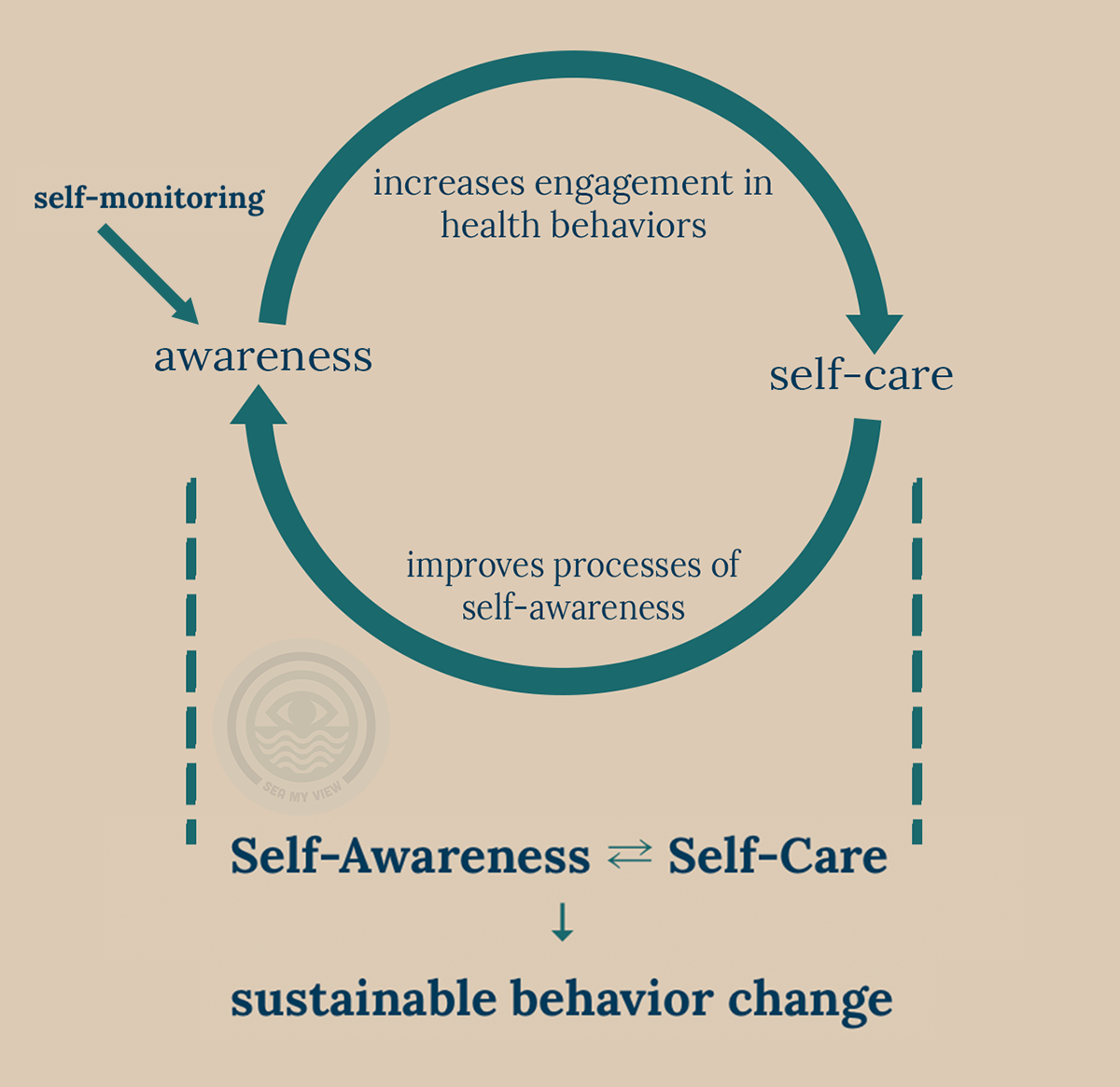
The following worksheets are self-monitoring measurement procedures - here to support you in initiating behavior change.
-
Self-awareness is a variety of processes, rather than a single ability. According to cognitive neuroscience - self-awareness comes from:
interoception - knowing how we feel - our ability to detect, interpret, and regulate internal bodily senses - such as anxiety, hunger, temperature, thirst, nausea, etc.
proprioception & body ownership - our ability to sense body position and movement & experiencing our body as belonging to ourselves
agency - sense of generating our own actions & our ability to predict the consequences of our actions
metacognition - our ability to detect, interpret, and regulate thoughts & evaluate our own skills
emotional regulation - our ability to detect, interpret, and regulate emotion
autobiographical memory - records of self-information (personal history) - including previous experiences & general information about oneself
Observation of Self-Awareness
Bring awareness to your lived experience – notice the small things that make your days feel lighter, what you return to, what you care about, and what brings you motivation for tomorrow.
Use the ikigai-inspired worksheet to explore these patterns and discover what already sustains you.
-
Self-care is the ongoing, essential practice of engaging in core health behaviors that support and improve mental health and overall well-being.
adequate sleep
social connections
physical activity
nutrition (diet & hydration) - balanced intake of energy (calories), macronutrients (carbohydrates, fats, proteins) & fluids (hydration)
stress management
Observation of Self-Care
Before pursing intentional change, it is essential we evaluate our current self-care - how connected we feel, how we move our bodies, how well we hydrate & nourish ourselves, how we manage stress, and the quality of our sleep.
Use the following worksheet to notice your current health behaviors - what is present & what you need more of - to better support yourself through change.
The purpose of this resource is observation - becoming aware of ourselves and our current self-care.
By observing rather than immediately asking ourselves to make adjustments, we remove some of the pressure associated with change.
The best bit is, we may find change occurs anyways - just through the act of noticing.
-
Does tracking behavior really help?
Yes - research shows that simply measuring behavior can influence it, even without additional intervention.
Why is self-care important for behavior change?
It directly affects executive function and emotional regulation, which are essential for planning, decision-making, and sustaining behavior change.
Is awareness alone enough to change behavior?
While just becoming aware of something can cause it to change, sustaining behavior change requires more – the ability to regulate our thoughts, feelings, and actions; manage stress; strong social support; planning; systems; repetition; etc. – awareness is the starting point.
What is impulse control?
Impulse control is the ability to pause, think, and consider consequences before acting.
What is attention control?
Attention control is the ability to prioritize relevant information, directing and sustaining focus while ignoring distractions.
What is executive function?
Executive function is a set of mental skills that enable essential goal-directed behaviors including - planning, working memory, impulse & attention control, and cognitive flexibility.
What is working memory?
Working memory is the ability to store and process new information.
What is cognitive flexibility?
Cognitive flexibility is our ability to pivot – update beliefs and adjust plans & behaviors when things change.
-
Environmental & Social Factors
We are focusing on behaviors within our control.
Environmental & social factors - financial security, stable housing, access to nutritious foods, etc. - are not necessarily within someone’s control to change.
When these basic needs are compromised, they dominate cognition & temporarily limit capacity, causing the brain to prioritize immediate survival over long-term planning & behavior change.
In this context, difficulties with initiating & maintaining behavior change are expected - not a personal limitation.
Try to be gentle with yourself through the process.
Potential Limitations of Self-Monitoring
Some people feel self-monitoring is boring, causing them to stop tracking or even stop working toward the goal altogether.
In other cases, when self-monitoring focuses too heavily on a single health behavior, it can cause negative health outcomes.
In this resource, these issues are addressed through an emphasis on social support and a more holistic, well-rounded approach to tracking health behaviors.
-
Self-Awareness and Sustainable Behavior Change
Self-awareness enhances self-regulation by strengthening our ability to:
recognize emotional and bodily states - emotional regulation, interoception
monitor thoughts and behaviors - metacognition
adjust actions intentionally - agency
learn from past experiences - autobiographical memory (personal history)
Self-awareness enhances stress reactivity & resilience by strengthening our ability to:
detect stress signals - interoception
regulate emotional reactions - emotional regulation
recognize unhelpful thought patterns - metacognition
maintain a sense of control during stressful situations - agency
apply stress management strategies from past experiences - autobiographical memory (personal history)
Self-awareness enhances interpersonal & social processes by strengthening our ability to:
understand emotions in ourselves & others - interoception, emotional regulation
communicate more effectively - metacognition, emotional regulation
build empathy & trust - emotional regulation, autobiographical memory (personal history)
maintain a stable sense of self within relationships - agency
connect through shared experiences - autobiographical memory
Self-Care for Sustainable Behavior Change
Self-care enhances self-regulation, stress reactivity & resilience, and interpersonal & social processes by strengthening the skills associated – restorative sleep, balanced nutrition, adequate hydration, stress management, strong social connections, and physical activity strengthen our ability to:
pause, think, and consider consequences before acting
detect, interpret, and regulate emotion
direct focus, ignore distractions, and prioritize relevant information
store and process new information
pivot – update beliefs and adjust plans & behaviors when things change
while engaging in all of the health behaviors of self-care is recommended - prioritizing just one has the ability to strengthen the skills necessary to support sustainable change
additions to the research
restorative sleep reduces misinterpretations of social cues and minimizes social conflict through accurate distinction of positive and negative emotions
even mild dehydration – which can occur through routine daily activities – weakens cognitive abilities
complex carbohydrates, omega-3s, protein, and healthy fats enhance executive functioning, whereas high-calorie diets weaken executive function
more social engagement & better social networks define strong social connections
those with ADHD saw greater improvements in executive function from physical activity than other populations
self-regulation includes both metacognition & emotional regulation, making it a process of self-awareness, as well as a key area of focus central to behavior change
interoception, agency, metacognition, emotional regulation & records of self-information are all processes of self-awareness, as well as skills associated with behavior change
stress management and social connections are both core health behaviors of self-care, as well as key areas of focus central to behavior change
-
Nielsen L, Riddle M, King JW, et al. The NIH Science of Behavior Change Program: Transforming the science through a focus on mechanisms of change. Behav Res Ther. 2018;101:3-11. doi:10.1016/j.brat.2017.07.002
Mograbi DC, Hall S, Arantes B, Huntley J. The cognitive neuroscience of self-awareness: Current framework, clinical implications, and future research directions. Wiley Interdiscip Rev Cogn Sci. 2024;15(2):e1670. doi:10.1002/wcs.1670
Hyndych A, El-Abassi R, Mader EC Jr. The Role of Sleep and the Effects of Sleep Loss on Cognitive, Affective, and Behavioral Processes. Cureus. 2025;17(5):e84232. Published 2025 May 16. doi:10.7759/cureus.84232
Riebl SK, Davy BM. The Hydration Equation: Update on Water Balance and Cognitive Performance. ACSMs Health Fit J. 2013;17(6):21-28. doi:10.1249/FIT.0b013e3182a9570f
Muth AK, Park SQ. The impact of dietary macronutrient intake on cognitive function and the brain. Clin Nutr. 2021;40(6):3999-4010. doi:10.1016/j.clnu.2021.04.043
Beilharz JE, Maniam J, Morris MJ. Diet-Induced Cognitive Deficits: The Role of Fat and Sugar, Potential Mechanisms and Nutritional Interventions. Nutrients. 2015;7(8):6719-6738. Published 2015 Aug 12. doi:10.3390/nu7085307
Shields GS, Sazma MA, Yonelinas AP. The effects of acute stress on core executive functions: A meta-analysis and comparison with cortisol. Neurosci Biobehav Rev. 2016;68:651-668. doi:10.1016/j.neubiorev.2016.06.038
Dodds L, Brayne C, Siette J. Associations between social networks, cognitive function, and quality of life among older adults in long-term care. BMC Geriatr. 2024;24(1):221. Published 2024 Mar 4. doi:10.1186/s12877-024-04794-9
Singh B, Bennett H, Miatke A, et al. Effectiveness of exercise for improving cognition, memory and executive function: a systematic umbrella review and meta-meta-analysis. Br J Sports Med. 2025;59(12):866-876. Published 2025 Jun 3. doi:10.1136/bjsports-2024-108589
Raihan N, Cogburn M. Stages of Change Theory. In: StatPearls. Treasure Island (FL): StatPearls Publishing; March 6, 2023.
French DP, Sutton S. Reactivity of measurement in health psychology: how much of a problem is it? What can be done about it?. Br J Health Psychol. 2010;15(Pt 3):453-468. doi:10.1348/135910710X492341
Orji R, Lomotey R, Oyibo K, Orji F, Blustein J, Shahid S. Tracking feels oppressive and 'punishy': Exploring the costs and benefits of self-monitoring for health and wellness. Digit Health. 2018;4:2055207618797554. Published 2018 Sep 3. doi:10.1177/2055207618797554
grazie · sea you next time · arrivederci