

How to Build a Daily Schedule that Supports Mental Health - According to Science
Dive into the science and discover practical, research-informed strategies to design a sustainable schedule, prioritizing self-care core health behaviors to support your mental health and overall well-being - making change easier to start and maintain!
they were changed - just as shorelines are shaped - by the constancy of their countless individual waves
Many of us only schedule self-care after everything else is done; an optional add-on - something that would be nice to include if we could.
“You should sit in meditation for twenty minutes every day - unless you're too busy; then you should sit for an hour.” - author unknown
Self-care is often framed as - indulgent, extra, earned. Whereas research supports self-care as - regulation, resilience, essential support.
To refresh, self-care is the ongoing practice of engaging in core health behaviors:
connectedness | restorative sleep | movement | stress management | nutrition
Schedules prioritizing self-care →
→ enhance our mental health
→ support overall well-being
→ make change easier to start & maintain
In this resource, we use self-observation and time blocking techniques to create a sustainable weekly schedule - prioritizing health over metrics of productivity - highlighting self-care as essential to the quality of our lives & our ability to change.
The Science Behind Time Management
We often think of time management in relation to work and productivity, and while research does show these areas improve - time management has an even stronger effect on our life satisfaction & our mental health.
As time management improves so does our → creativity, motivation, life satisfaction, sense of purpose, wellbeing & mental health
While simultaneously we see decreases in our → stress, emotional exhaustion, hopelessness, anxiety & mental health struggles
How to Create a Sustainable Schedule that Works for You
Step 1: Identify Core Life Obligations
These usually fall into three categories:
maintenance (essential biological functions) - sleeping, eating, hydrating, personal hygiene
employment & learning - time spent earning a living and on formal education & study - seeking employment & setting up a business belong here
unpaid caregiving & domestic services - childcare, eldercare, helping partners and family members, cooking (planning & preparation), household chores, pet care, shopping
Step 2: Supporting Tasks
Some obligations will require time blocks for supporting tasks, such as:
winding down before sleep
meal planning, grocery shopping, cooking
traveling and commuting
schedule maintenance / planning
as you build out your schedule - include these additional time blocks to ensure sustainability
Step 3: Time & Frequency
Estimate time requirements, as well as frequency - daily, weekly, monthly, etc.
When estimating time, be sure to consider transitioning - phase changing - refocusing - it is always better to overestimate than under.
This might be your first time associating your actions with time - as you use your schedule, you will continue to refine your estimates.
awareness > exact accuracy
When structuring my days, I use a variation of the Pomodoro Technique - a time-management method that research has shown can enhance focus & support more effective use of time.
-
The Pomodoro Technique is a time-management method that uses focused work sessions followed by short breaks.
Some Examples of Studied Variations:
Variation One:
4 × 90 min | 30 min break
90 min work session, followed by 30 min break, repeated 4 times
8-hour work day has 2 hours of breaks = 6 hours total work output
Variation Two:
4 × 50 min | 15 min break
50 min work session, followed by 15 min break, repeated 4 times
4 hrs & 20 mins of work has 1 hr of break = 3 hrs & 20 mins total work output
Step 4: Identify Day Types
Designing a schedule from a blank slate each week can be overwhelming & time consuming. This is why I began creating day type templates for myself, instead looking for patterns & asking - what kinds of days do I actually have?
on-site vs remote work days
class schedules vs study days
days with fixed drop-off & pick-up times - school, daycare, extracurriculars, eldercare
recurring activities for self or others
Designing simple, reusable templates for recurring day types helps reduce the mental load, increases our likelihood of continuing to maintain a schedule, and provides a starting framework for our weekly planning.
Then time can be spent reviewing and incorporating new or unique items for that week, rather than starting completely over.
Step 5: Templates & Anchors
To create basic recurring day type templates, begin by sorting your obligations and support tasks from steps 1 & 2 by frequency:
all days: sleeping, eating, cooking or ordering out, personal hygiene, working, etc.
on-site work days: commute time
once a week: planning, cleaning, groceries, etc.
Then, start with anchors - blocks that happen at roughly the same time each day, such as:
sleep & wake times*
meals
work hours
school drop-off & pick-up
Lastly, add the obligations and support tasks around the anchors, for each of the day types.
*I always prioritize sleep & wake times first, as adequate sleep is essential to everything
Step 6: Evaluate Discretionary Time
We want our schedules to have about two hours available every day to spend however we want - this is called discretionary time.
Research shows life satisfaction peaks when our days have 2-5 hours of discretionary time.
those with less than 2 hrs. felt more stressed
those with more than 5 hrs. felt less productive
While researchers identified ways to remove the negative impacts of excess time - more on that later - both “too little” & “too much” can lead to lower life satisfaction & lower overall well-being.
-
If your current schedule does not allow for at least 2 hours of discretionary time, consider -
auditing, eliminating, delegating, renegotiating boundaries, combining, etc.If it is still not feasible, I provide options below on how you can still ensure all core self-care health behaviors are supported within your days, within your capacity.
-
If you are one of the lucky few to have more than 5 hours of discretionary time – how you choose to spend that time, determines the outcome.
Researches no longer observed the negative impact to life satisfaction and overall well-being - when excess time was spent on social & productive activities.
Research on Solo vs Social Time:
When people spend their discretionary time solo – there is a limit to the amount that actually benefits well-being -
around 2.5 hours maxWhen people spend their discretionary time socially, more is better –
researchers only observed the too much time effect when that discretionary time did not offer the value of social connection.Research on Nonproductive vs Productive Time:
When people spend their discretionary time on nonproductive activities – there is a limit to the amount that actually benefits well-being -
around 3 hours maxWhen people spend their discretionary time on productive activities, they did not find a limit that lowered well-being –
researchers only observed the too much time effect when that discretionary time felt “wasted” or “did not feel useful, meaningful, or fulfilling”productive activities are ones you consider the use of time to: not be wasted & feel useful, accomplished, fulfilling, helpful, purposeful, worthwhile
nonproductive activities are ones you consider the use of time to be wasted & not feel useful, accomplished, fulfilling, helpful, purposeful, worthwhile
more than 50% of those surveyed considered the following activities to be nonproductive -
watching television / movies, watching sports, going to the casino, tobacco and drug use
Step 7: Determine Support Needs → Match Strategy to Reality
Identify What Needs Support
Think back to the self-monitoring worksheets from resource one & the observations made.
Using what you noticed about your self-care - identity one health behavior to support first.
Match Your Strategy to Your Reality
Choose the strategy based on your capacity -
If you have discretionary time →
Use some of the time to intentionally support your chosen self-care health behavior.
If you have little or no discretionary time →
Either satisfy multiple health behaviors at once or look for opportunities within existing activities to support your self-care.
-
examples - general
consistent sleep & wake schedule
wind-down or morning routine
daily walks
5 mins of intentional movement
weekly catch-up with a friend
one moment of connection, daily
weekly time block to find nourishing recipes
block off extra time around meals
add one stress management practice, daily
examples - combining health behaviors
walking with a friend supports movement and connection
preparing meals with family members supports nutrition and connectedness (relationships)
integrating stress reducing practices into your evening supports sleep and stress management
daily movement supports sleep
movement practices can be stress management practices
find activities that support stress management and allow you to socially connect
calling a friend on an evening walk supports connectedness, movement, restorative sleep
examples - within existing activities
use commute for stress management through music, mindfulness, learning
run errands or go grocery shopping with a friend to support connection
connect with a friend during your commutes
turn family time into movement through walks or active play
consider meals that yield multiple servings to free up meal blocks later
use breaks for stretching, breathing practices, or brief social connections
integrate stress management into getting ready by listening to guided meditations, music, audiobooks, podcasts, etc.
add movement to your day by taking the stairs or standing whilst working
Research consistently shows all self-care health behaviors should be protected within our schedules - sleep, movement, connection, nutrition, stress management
Making it important to find creative ways in which they are all addressed within your available capacity.
We are not looking to optimize just yet, we are looking to prioritize sustainable, supportive structures we can build from.
splash of commentary - a note on sleep
-
Unlike many of the other self-care health behaviors - sleep is already built into every schedule - it may just need to be better supported or strengthened.
Inadequate sleep impacts just about everything - from our brains and our bodies to our relationships and our emotions - humans can survive longer without food than without sleep.
Even just getting less than 7 hours per night, over time, can cause:
weight gain and obesity
diabetes
high blood pressure
heart disease and stroke
depression
increased risk of death
difficulties managing strong feelings
increased anxiety
difficulties paying attention
increased relationship difficulties, including heightened marital conflicts & negative social behaviors
difficulties retaining information
if adding in self-care health behaviors feels overwhelming, try starting with sleep - you may find momentum from there
Step 8: Define Details
Before we can implement our schedule, we need to define the details - turning broad category blocks into specific actions.
From general ideas to detailed support plans - the level of complexity is up to you.
-
once a week → update broad categories for the week ahead
once or twice a month → create or update support plans, if applicable
morning nourishment →
general idea of what you will eat
create / follow meal planmovement →
walk around the neighborhood
create / follow fitness planconnectedness →
coffee with a friendstress management →
10 min meditationcleaning →
create chore list / cleaning schedule
include additional time blocks within your schedule to support your desired level of planning
Step 9: Begin → Review → Adjust
After using your schedule for at least a week, take a moment to review:
-
what's working well?
did anything feel difficult to maintain?
what has felt supportive?
does anything need to shift or change? - blocks that need more or less time?
does anything feel out of place? - maybe scheduled on the wrong day or time of day, based on your energy and needs
did anything feel missing?
A sustainable schedule should be a flexible system rather than a fixed plan - continue to adjust, as needed, to fit your life.
While the purpose of this resource was to use time blocking to create sustainable schedules that integrate self-care in ways that fit our current circumstances - the techniques can be applied generally, as well - acting as a base to build from when pursing passions and larger goals, later on.
Even when time is limited, small, consistent actions make meaningful differences.
-
For some of us, a schedule void of long-term goals and growth areas, may feel like a lack of ambition – rather this was an intentional choice of mine, to have us focus on stability first.
Research shows without these core health behaviors being met - change is harder and less likely to occur and continue - and can greatly impacting our physical and mental health.
Once our schedules support our needs and functioning – pursuing long-term goals, growth areas, etc. will be easier, as without structure, change lacks the container to take root.
-
Jacobs S. How to Start Making Changes - According to Science. Sea My View. May 23, 2026. Accessed June 1, 2026. https://www.seamyview.com/spring/how-to-start-making-changes.
Aeon B, Faber A, Panaccio A. Does time management work? A meta-analysis. PLoS One. 2021;16(1):e0245066. Published 2021 Jan 11. doi:10.1371/journal.pone.0245066
Ogut E. Assessing the efficacy of the Pomodoro technique in enhancing anatomy lesson retention during study sessions: a scoping review. BMC Med Educ. 2025;25(1):1440. Published 2025 Oct 17. doi:10.1186/s12909-025-08001-0
Sharif MA, Mogilner C, Hershfield HE. Having too little or too much time is linked to lower subjective well-being. J Pers Soc Psychol. 2021;121(4):933-947. doi:10.1037/pspp0000391
Shah AS, Pant MR, Bommasamudram T, et al. Effects of Sleep Deprivation on Physical and Mental Health Outcomes: An Umbrella Review. Am J Lifestyle Med. Published online May 27, 2025. doi:10.1177/15598276251346752
Hyndych A, El-Abassi R, Mader EC Jr. The Role of Sleep and the Effects of Sleep Loss on Cognitive, Affective, and Behavioral Processes. Cureus. 2025;17(5):e84232. Published 2025 May 16. doi:10.7759/cureus.84232
grazie · sea you next time · arrivederci

How to Start Making Changes - According to Science
Dive into the science and discover practical, research-informed strategies to initiate and maintain personal change!
You ever feel that familiar pull to reset – to change something about your life, start fresh?
Maybe you want to break a habit, create a routine, or implement a daily practice, and are curious where to begin - that’s where science comes in.
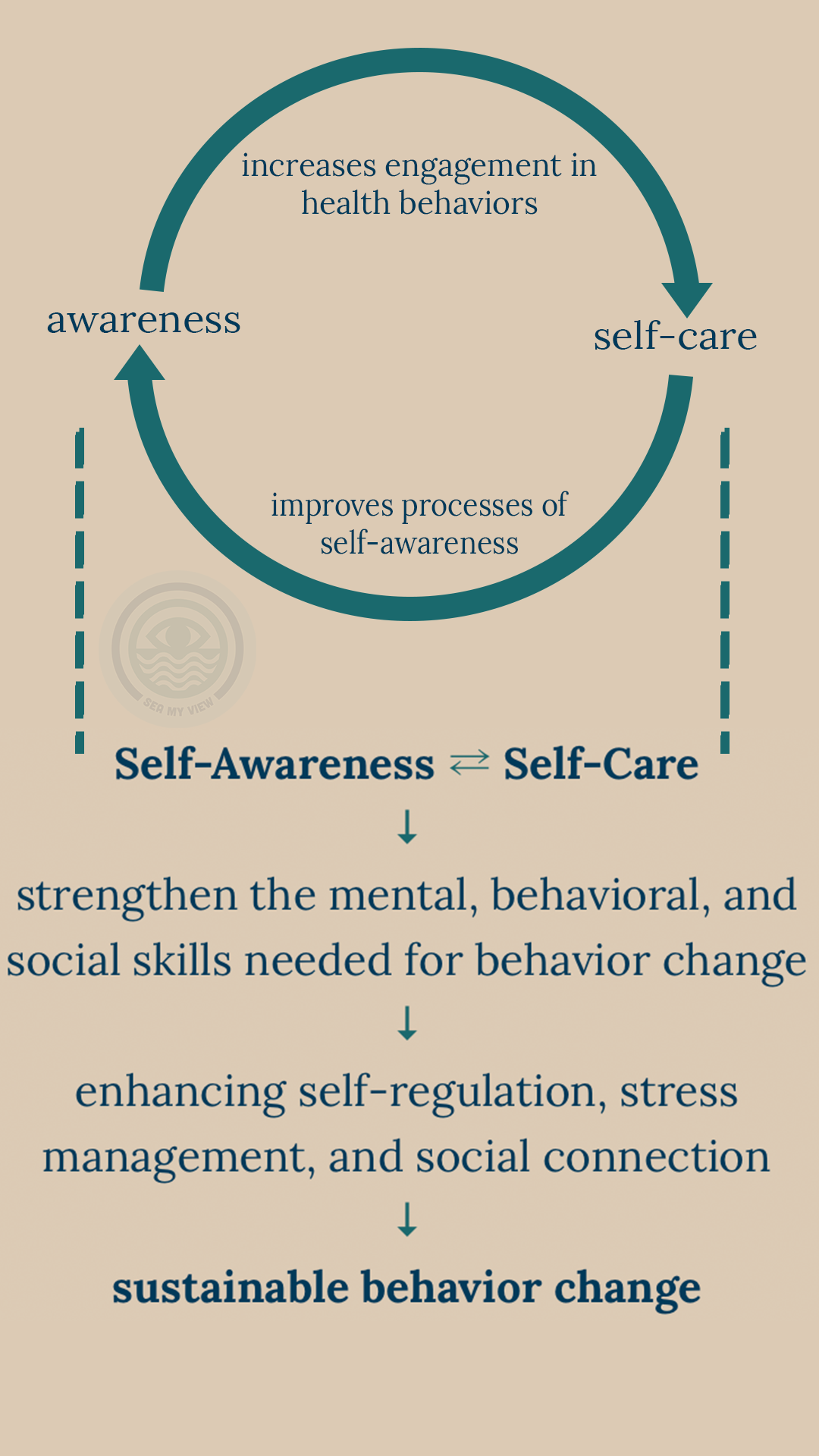
By combining research from the fields of behavioral science, cognitive & nutritional neuroscience, and psychology - a recurring pattern emerged: self-awareness & self-care strengthen the skills needed to initiate, support, and sustain behavior change.
This resource connects these findings - illustrating self-awareness & self-care as research-informed starting points for sustainable behavior change.
The Science Behind Sustainable Change
Research highlights three key areas of focus central to initiating & maintaining behavior change:
self-regulation: the ability to manage our thoughts, emotions, and behaviors to achieve a desired goal
stress reactivity & resilience (stress management): our ability to identify and handle stress - including how we react to it & how well we recover from it
interpersonal & social processes (social connections): our ability to feel a sense of belonging & closeness with others through communication & shared activities - and how those connections shape our choices and experiences
Within these three key areas, researchers identified mental, behavioral & social skills associated with behavior change success.
Prioritizing practices that strengthen those skills make sustainable behavior change easier and more likely to occur.
Self-Awareness & Self-Care for Sustainable Behavior Change
Self-Awareness & Self-Care →
enhance our ability to
→ regulate our thoughts, emotions & behaviors
→ respond to & recover from stress
→ navigate social interactions & better engage with others
Individually, self-awareness & self-care reinforce the key areas of sustainable behavior change.
Together, through a reinforcing system of insight & action, they continuously strengthen each other.
Self-Awareness ⇄ Self-Care →
Sustainable Behavior Change
Start Here for Sustainable Behavior Change
“Until you make the unconscious conscious, it will direct your life and you will call it fate.” - Carl Jung
Start with Awareness
We cannot change, what we do not notice.
A common framework for understanding human behavior & the process of change is the stages of change theory (TTM) - precontemplation, contemplation, preparation, action, maintenance.
To initiate change, we must move from unawareness (precontemplation) to awareness (contemplation).
The Magic of Measuring
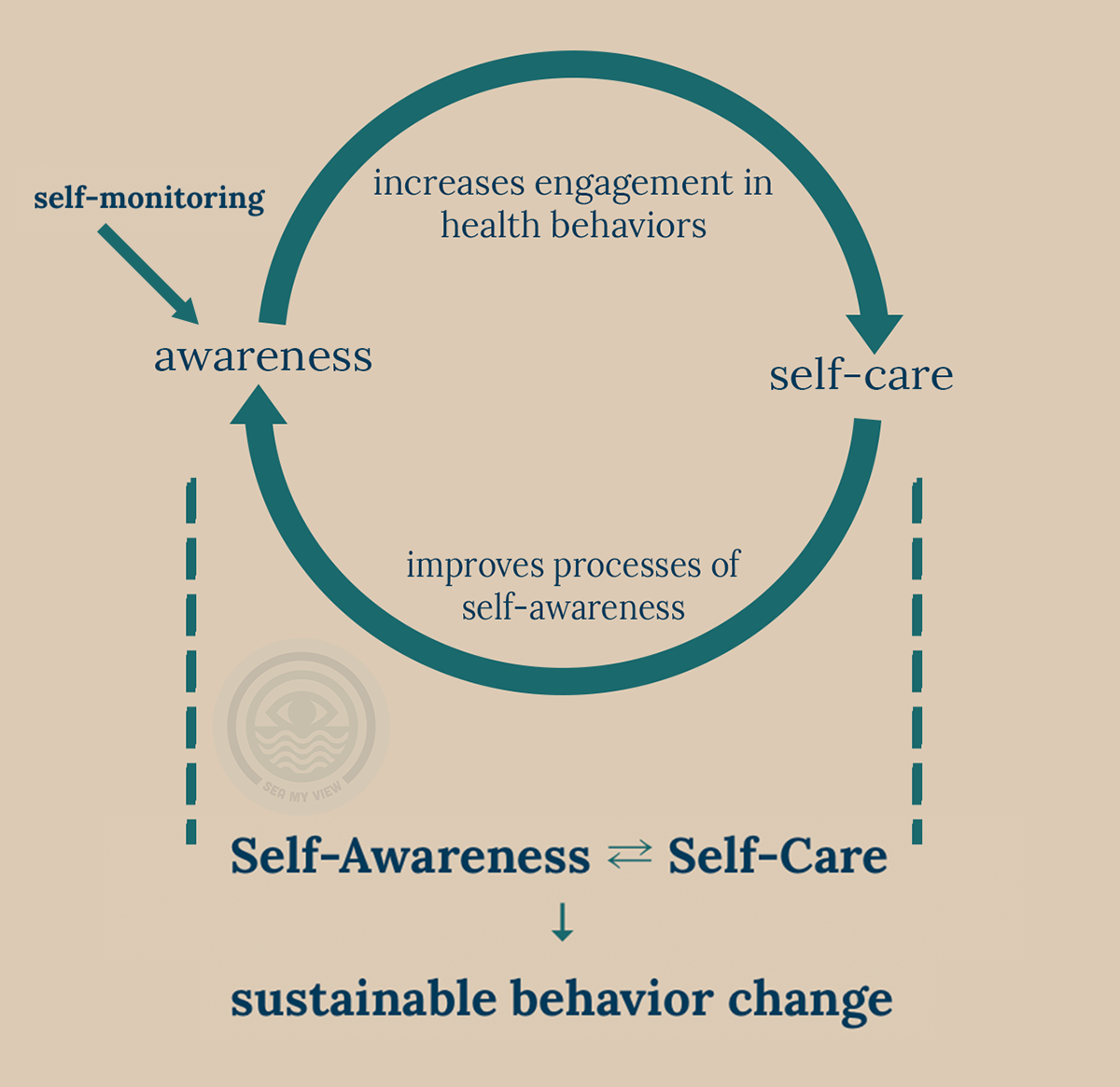
There is a fascinating phenomenon in behavioral science called measurement reactivity - where just observing, tracking, or being asked about an action, thought, or feeling - causes it to change.
Measurement reactivity occurs from measurement procedures such as self-monitoring - tracking & evaluating your actions, thoughts & feelings over time.
Self-monitoring is effective at promoting health & well-being by creating awareness - revealing problem behaviors, deepening our knowledge & understanding, and increasing motivation.
Self-Monitoring in Practice
The act of measuring creates awareness, and awareness increases engagement in self-care - bringing us back to our reinforcing system.
The following worksheets are self-monitoring measurement procedures - here to support you in initiating behavior change.
-
Self-awareness is a variety of processes, rather than a single ability. According to cognitive neuroscience - self-awareness comes from:
interoception - knowing how we feel - our ability to detect, interpret, and regulate internal bodily senses - such as anxiety, hunger, temperature, thirst, nausea, etc.
proprioception & body ownership - our ability to sense body position and movement & experiencing our body as belonging to ourselves
agency - sense of generating our own actions & our ability to predict the consequences of our actions
metacognition - our ability to detect, interpret, and regulate thoughts & evaluate our own skills
emotional regulation - our ability to detect, interpret, and regulate emotion
autobiographical memory - records of self-information (personal history) - including previous experiences & general information about oneself
Observation of Self-Awareness
Bring awareness to your lived experience – notice the small things that make your days feel lighter, what you return to, what you care about, and what brings you motivation for tomorrow.
Use the ikigai-inspired worksheet to explore these patterns and discover what already sustains you.
-
Self-care is the ongoing, essential practice of engaging in core health behaviors that support and improve mental health and overall well-being.
adequate sleep
social connections
physical activity
nutrition (diet & hydration) - balanced intake of energy (calories), macronutrients (carbohydrates, fats, proteins) & fluids (hydration)
stress management
Observation of Self-Care
Before pursing intentional change, it is essential we evaluate our current self-care - how connected we feel, how we move our bodies, how well we hydrate & nourish ourselves, how we manage stress, and the quality of our sleep.
Use the following worksheet to notice your current health behaviors - what is present & what you need more of - to better support yourself through change.
The purpose of this resource is observation - becoming aware of ourselves and our current self-care.
By observing rather than immediately asking ourselves to make adjustments, we remove some of the pressure associated with change.
The best bit is, we may find change occurs anyways - just through the act of noticing.
-
Does tracking behavior really help?
Yes - research shows that simply measuring behavior can influence it, even without additional intervention.
Why is self-care important for behavior change?
It directly affects executive function and emotional regulation, which are essential for planning, decision-making, and sustaining behavior change.
Is awareness alone enough to change behavior?
While just becoming aware of something can cause it to change, sustaining behavior change requires more – the ability to regulate our thoughts, feelings, and actions; manage stress; strong social support; planning; systems; repetition; etc. – awareness is the starting point.
What is impulse control?
Impulse control is the ability to pause, think, and consider consequences before acting.
What is attention control?
Attention control is the ability to prioritize relevant information, directing and sustaining focus while ignoring distractions.
What is executive function?
Executive function is a set of mental skills that enable essential goal-directed behaviors including - planning, working memory, impulse & attention control, and cognitive flexibility.
What is working memory?
Working memory is the ability to store and process new information.
What is cognitive flexibility?
Cognitive flexibility is our ability to pivot – update beliefs and adjust plans & behaviors when things change.
-
Environmental & Social Factors
We are focusing on behaviors within our control.
Environmental & social factors - financial security, stable housing, access to nutritious foods, etc. - are not necessarily within someone’s control to change.
When these basic needs are compromised, they dominate cognition & temporarily limit capacity, causing the brain to prioritize immediate survival over long-term planning & behavior change.
In this context, difficulties with initiating & maintaining behavior change are expected - not a personal limitation.
Try to be gentle with yourself through the process.
Potential Limitations of Self-Monitoring
Some people feel self-monitoring is boring, causing them to stop tracking or even stop working toward the goal altogether.
In other cases, when self-monitoring focuses too heavily on a single health behavior, it can cause negative health outcomes.
In this resource, these issues are addressed through an emphasis on social support and a more holistic, well-rounded approach to tracking health behaviors.
-
Self-Awareness and Sustainable Behavior Change
Self-awareness enhances self-regulation by strengthening our ability to:
recognize emotional and bodily states - emotional regulation, interoception
monitor thoughts and behaviors - metacognition
adjust actions intentionally - agency
learn from past experiences - autobiographical memory (personal history)
Self-awareness enhances stress reactivity & resilience by strengthening our ability to:
detect stress signals - interoception
regulate emotional reactions - emotional regulation
recognize unhelpful thought patterns - metacognition
maintain a sense of control during stressful situations - agency
apply stress management strategies from past experiences - autobiographical memory (personal history)
Self-awareness enhances interpersonal & social processes by strengthening our ability to:
understand emotions in ourselves & others - interoception, emotional regulation
communicate more effectively - metacognition, emotional regulation
build empathy & trust - emotional regulation, autobiographical memory (personal history)
maintain a stable sense of self within relationships - agency
connect through shared experiences - autobiographical memory
Self-Care for Sustainable Behavior Change
Self-care enhances self-regulation, stress reactivity & resilience, and interpersonal & social processes by strengthening the skills associated – restorative sleep, balanced nutrition, adequate hydration, stress management, strong social connections, and physical activity strengthen our ability to:
pause, think, and consider consequences before acting
detect, interpret, and regulate emotion
direct focus, ignore distractions, and prioritize relevant information
store and process new information
pivot – update beliefs and adjust plans & behaviors when things change
while engaging in all of the health behaviors of self-care is recommended - prioritizing just one has the ability to strengthen the skills necessary to support sustainable change
additions to the research
restorative sleep reduces misinterpretations of social cues and minimizes social conflict through accurate distinction of positive and negative emotions
even mild dehydration – which can occur through routine daily activities – weakens cognitive abilities
complex carbohydrates, omega-3s, protein, and healthy fats enhance executive functioning, whereas high-calorie diets weaken executive function
more social engagement & better social networks define strong social connections
those with ADHD saw greater improvements in executive function from physical activity than other populations
self-regulation includes both metacognition & emotional regulation, making it a process of self-awareness, as well as a key area of focus central to behavior change
interoception, agency, metacognition, emotional regulation & records of self-information are all processes of self-awareness, as well as skills associated with behavior change
stress management and social connections are both core health behaviors of self-care, as well as key areas of focus central to behavior change
-
Nielsen L, Riddle M, King JW, et al. The NIH Science of Behavior Change Program: Transforming the science through a focus on mechanisms of change. Behav Res Ther. 2018;101:3-11. doi:10.1016/j.brat.2017.07.002
Mograbi DC, Hall S, Arantes B, Huntley J. The cognitive neuroscience of self-awareness: Current framework, clinical implications, and future research directions. Wiley Interdiscip Rev Cogn Sci. 2024;15(2):e1670. doi:10.1002/wcs.1670
Hyndych A, El-Abassi R, Mader EC Jr. The Role of Sleep and the Effects of Sleep Loss on Cognitive, Affective, and Behavioral Processes. Cureus. 2025;17(5):e84232. Published 2025 May 16. doi:10.7759/cureus.84232
Riebl SK, Davy BM. The Hydration Equation: Update on Water Balance and Cognitive Performance. ACSMs Health Fit J. 2013;17(6):21-28. doi:10.1249/FIT.0b013e3182a9570f
Muth AK, Park SQ. The impact of dietary macronutrient intake on cognitive function and the brain. Clin Nutr. 2021;40(6):3999-4010. doi:10.1016/j.clnu.2021.04.043
Beilharz JE, Maniam J, Morris MJ. Diet-Induced Cognitive Deficits: The Role of Fat and Sugar, Potential Mechanisms and Nutritional Interventions. Nutrients. 2015;7(8):6719-6738. Published 2015 Aug 12. doi:10.3390/nu7085307
Shields GS, Sazma MA, Yonelinas AP. The effects of acute stress on core executive functions: A meta-analysis and comparison with cortisol. Neurosci Biobehav Rev. 2016;68:651-668. doi:10.1016/j.neubiorev.2016.06.038
Dodds L, Brayne C, Siette J. Associations between social networks, cognitive function, and quality of life among older adults in long-term care. BMC Geriatr. 2024;24(1):221. Published 2024 Mar 4. doi:10.1186/s12877-024-04794-9
Singh B, Bennett H, Miatke A, et al. Effectiveness of exercise for improving cognition, memory and executive function: a systematic umbrella review and meta-meta-analysis. Br J Sports Med. 2025;59(12):866-876. Published 2025 Jun 3. doi:10.1136/bjsports-2024-108589
Raihan N, Cogburn M. Stages of Change Theory. In: StatPearls. Treasure Island (FL): StatPearls Publishing; March 6, 2023.
French DP, Sutton S. Reactivity of measurement in health psychology: how much of a problem is it? What can be done about it?. Br J Health Psychol. 2010;15(Pt 3):453-468. doi:10.1348/135910710X492341
Orji R, Lomotey R, Oyibo K, Orji F, Blustein J, Shahid S. Tracking feels oppressive and 'punishy': Exploring the costs and benefits of self-monitoring for health and wellness. Digit Health. 2018;4:2055207618797554. Published 2018 Sep 3. doi:10.1177/2055207618797554
grazie · sea you next time · arrivederci